
Τhe working environment has not been the same since Covid. Ideas such as work from home, online trading, transactions in digital currency, etc. that may have been frowned upon before, are now encouraged and capitalised to their full potential. If making money has never been easier before, it surely has not disappointed the masses in exploiting them yet again. Many have lost in this race, whilst others had to give up on their leisure time while trying to make more. This also meant an increase in the ratio of people living off on instant meals and ready to go products, to manage time. Therefore, we see that the cash influx in the retail industries and FMCG has generously increased. Fast food companies hence, thrive off of the sales they make. They continue to make profits by reading consumer behaviour and observing their cash flow cycle. Which is where we come to see what cash flow is, how a cash flow statement is generated, and how it tells us the condition of a business?
What is Cash Flow?
Cashflow is the money coming in and going out of the business. A cash flow statement analysis concludes the cash flow (CF) over a certain time period. Typically, from the start to the end of a year, or of a few months (two, or three, etc.) over specific intervals. It maps out where the money is coming from, what the sources are; where it is being spent and on what?
Statement of cash flow
The statement of cash flow comprises of:
- Working Capital (Operational Cash Flow)
- Financing
- Investing
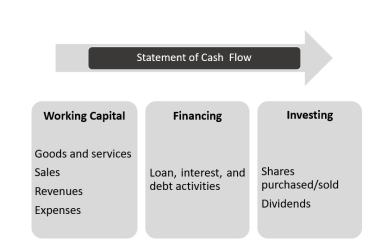
Operational CF is the money from the goods and services, i.e., the revenue and expenses. Financing is the loan or debt activities, any debt to be paid off is listed here. Whereas, investing will be the shares purchased or sold.
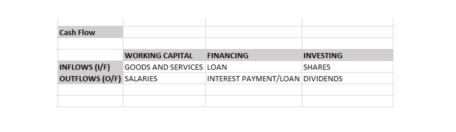
How does the cash flow? Inflows-outflows
The money from the sales, loans, and shares (inflows – I/F) goes to salaries, interest/loan payments, and dividends (outflows – O/F).
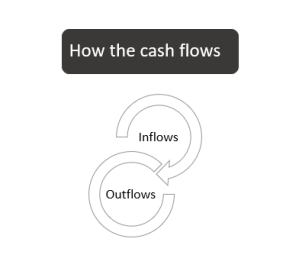
Is the business doing fine? Cashflow determines:
Cash flow (CF) determines whether the company or business is doing well or not. It keeps a check on what situation the business is in.
Generated CF can be positive or negative.
- Positive CF
A positive CF can indicate that the business will do good in the future. It is like a fortune reading of the coming good tidings.
- Negative CF
A negative CF will beware the shareholders, investors, and owners to take measured steps in the future, to overcome what has been lost.
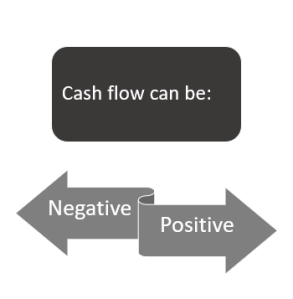
CF plays a significant role in the world of business by analysing a company’s condition. A positive CF is a sign of an increase in liquidity, i.e., enough assets/money stored which can be urgently used if need be. Whereas, a negative number coming at the end warns us about potential problems that may arise in the future.
Conclusion
To sum it up, Cash Flow gives a detailed account of the money being earned or spent in a certain period, followed in regular intervals. It is analysed by a statement which gives a clear view of the Operational CF, Financing and Investing. It tells us what kind of money is being stocked up. Not only that, the CF statement can also show if there’s any shortage of funds. That way, it becomes easier for a company to be prepared for challenges ahead of time, as well as, even cover those gaps and find the problem at its root.
Therefore, we realise that Cash Flow analysis is an essential process for any business (small or large), in making a decision, planning, and acting on it for the potential growth and smooth sailing of a business/company.
[wpapp_social]

